
A Mennonite blog post | By Michel Monette, a repentant church planter
⚠️ A Warning to Easily Offended Readers
This text is written by a Mennonite — a spiritual descendant of Anabaptists who refused power, empire, and grand cathedrals from the 16th century onward. People who were burned alive, drowned, and imprisoned precisely because they believed the church was not a building, not a spectacle, not an institution of power — but a community of disciples living the life of Christ together. I warn you: if you are expecting a soft, ecumenical article, stop here. Because I am about to name something difficult to hear.
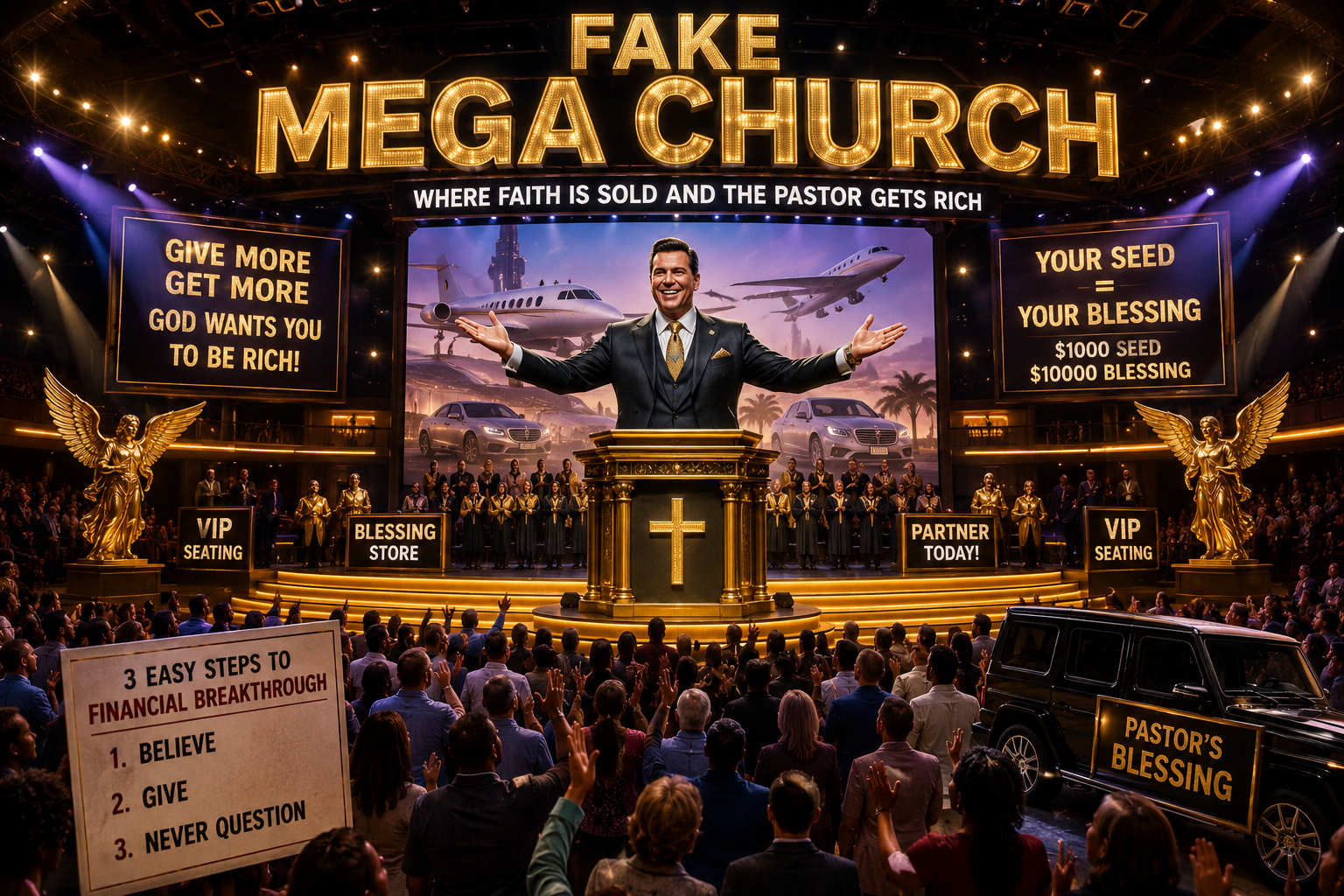
What we call « church planting » today — in the vast majority of cases — is fake. A Fake Church.
In the Beginning, the Right Intention
I started planting churches in 1998. We would form a core group, organize Bible studies, Sunday services, evangelism. The intention was sincere. The momentum, real. But very early on, something was off. The model we were being taught came from somewhere. And that somewhere was always the same: the United States. The mega-churches. Think Big. The grand spectacle.
We recruited « planters » like entrepreneurs. We gave them personality tests, sent them to a few-day Boot Camp to learn how to plan a worship service, manage a praise team, build a Sunday school program, and collect tithes. Voilà. Now you have a church!
Really? Is that really what a church is?
🎤 The Hillsong Model: When the Church Becomes a Concert
Then came the Hillsong model — born in Australia, but quickly adopted around the world as the ultimate reference of « ecclesiastical success ». A model built on spectacle, performance, sensory experience. We moved from « you have to hear this » to « you have to experience this ». Faith was no longer teaching. It was a thrill. Sermons increasingly resembled TED talks with light-and-smoke ambience. The goal was no longer to teach. It was to stimulate. And the Sunday-morning metric evangelists, with their growth-data dashboards, were happy: the numbers were rising!
But were we forming disciples — or spectators?
🖥️ COVID Revealed Everything
Then came COVID-19. And with it, the most brutal exposure of the model. Worship venues closed. And suddenly, what we had called « church » no longer existed, because the room no longer existed.
We then taught Christians something revealing: YouTube can replace Sunday morning. And they believed it. Because for years they had been told that church was 2 to 4 hours a week, on Sunday, in a nice room with a good show. They simply learned to consume that product from their couch.
And Christians did not return. Not all. Not most. YouTube's algorithm now does the job — better, even: same content, different speaker, no parking fee, no half-hour of administrative red tape.
« Churches are emptying out in favour of YouTube. »
That is the verdict. That is the fruit of the Fake Church model. When your church can be replaced by a YouTube channel — it was not really a church.
🚨 Naming the Impostor: the Fake Church
Let me be clear. The term « Fake Church » does not refer to fake or hypocritical Christians — it refers to an ecclesiological model that imitates the form of the church without its substance. A model that took the capitalist categories of success — growth, numbers, buildings, brands — and baptized them in the name of divine favour.
Here are the symptoms of the Fake Church. Do you recognize your church?
- The number of seats filled defines the church's success.
- The quest for a « charismatic » pastor replaces the formation of disciples.
- The sound budget exceeds the missions budget.
- The church grows in size but its members do not know each other.
- The pastor is a brand, not a servant.
- Discipleship is an optional Wednesday-night program.
- The preaching comforts the comfortable and drowns out the discomfort of others.
Megachurches represent less than 5% of churches worldwide. But they speak the loudest, they have the best marketing campaigns, they produce the books, the curricula, the Boot Camps. And through cultural contamination, they dictate the criteria of « success » to all the others. It is an ecclesiological colonization. And it is time to decolonize our vision of the church.
✍️ The Church According to Jesus — Returning to Anabaptist Sources
Matthew 16:18 — Jesus says to Peter:
« And I tell you that you are Peter, and on this rock I will build my church, and the gates of Hades will not overcome it. »
The Greek word « ekklesia » means an assembly of people called together. It is God who calls. It is Christ who gathers. Not the pastor with his PowerPoint and Facebook ad budget. Not the ecclesial strategy committee meeting in a weekend Boot Camp.
Jesus had 12 disciples. Not 12,000. He lived with them. 24/7, 365 days a year. For three years, he shared his life with them. He formed them through example, correction, common prayer, meals, walks, moments of doubt and faith.
The 5,000 he fed? He did not call them disciples. He healed them, taught them, fed them. And he slipped away. In a modern Fake Church, we would have filled out registration forms, created a mailing list, and invited the 5,000 to join the church Facebook group. Jesus went off to the mountain to pray.
Jesus did not seek crowds. He formed disciples.
Mennonites — Anabaptists — understood this long ago. It is no accident that they never built cathedrals. Or megachurch buildings. Or international religious brands. For them, the church is the community of those who walk together in the way of Christ — in their neighbourhood, in their daily life, with their neighbours, in simplicity and mutual accountability.
💰 Money, the Real Test
Here is a simple test: ask any planter or pastor why he is coming to see you. In the vast majority of cases, the answer revolves around one axis — financial needs. The venue, the salary, the sound equipment, the projector, the church van.
Megachurches are economic vortexes. They draw in the resources, talents, people, and gifts of surrounding communities. Then they measure their success against capitalist criteria: growth, budget, room capacity, number of campuses.
The Kingdom of God is not measured in those terms. It is measured in transformed lives. In reconciliations. In the poor fed. In prisoners visited. In strangers received. In healed communities. Matthew 25. Read it again.
« For I was hungry and you gave me something to eat, I was thirsty and you gave me something to drink, I was a stranger and you invited me in. » — Matthew 25:35 (NIV)
🛣️ The Way Out: Decolonize the Church
I had a very rich conversation with Timothy Keener, executive director of Direction chrétienne (Christian Direction) in Montreal. We agreed very quickly: we are operating on models imported from the United States, inherited without update for decades. Models that do not respond to the realities of Quebec, France, Africa, or Asia. They respond to the realities of the American Bible Belt — and even there, they are cracking.
So what do we propose instead? Not another program. Not another off-the-shelf model. Here are a few Anabaptist paths, tested by centuries of persecution and resilient community:
- Stop planting churches. Start deploying disciples.
- The venue is not a precondition. A BBQ, a kitchen, a kitchen table — those are places of church.
- Success is not the number of seats. It is the number of lives transformed on your street.
- Look for the « peacekeepers » in your neighbourhood — those men and women who already practise grace, mutual aid, and love without even naming it that way. Jesus called them « people of peace » (Matthew 10:11). They are the workers of the harvest.
- Take 6 to 12 people. Devote time, love, and presence to them. Walk with them. Expect to see lives transformed.
Looking for a leader in your community? Whoever can organize a BBQ can lead. Jesus will make the necessary corrections.
💎 What the Stones Cry Out
Jesus said the stones would cry out his praise if no one else did. Today, the stones that speak are the unchurched. The non-Christians on your street who practise grace, mutual aid, forgiveness, and mercy better than many Sunday assemblies. Those men and women filled with Love without knowing it. They are the church Christ is gathering, even if they do not yet know it.
And the Fake Church? It plants itself at the crossroads of their lives to throw their sins and foolishness in their face. Even Jesus did not do that. Not to the prostitute. Not to the rich young man. Not to the sinners on the boat. He forgave, even before being asked. He loved first. He asked questions. He invited. Never imposed.
Are we not his disciples? Then let us stop preaching condemnation from our neon-lit stages. Let us stop « cutting off ears » with our theological sword. And let us begin to love, simply, concretely, unconditionally.
✏️ Conclusion: I Am No Longer a Church Planter
Today, I am searching for the church that Christ is gathering. I no longer plant. He is the one who plants, and he shows me where, when, and with whom to go. I am not a church planter. I am a disciple of Christ who wants to work with him. I do not ask him to bless my project. I ask him to show me where he is at work — and to use me there, if such is his will.
Are you a pastor and watching attendance shrink? Give thanks. He is the one who gathers. Those who are still there are the ones he has placed under your care. Take care of them. Deeply. Personally. Not with one more program.
Making disciples takes time and self-denial. Not pews and music.
Go to your BBQs. To your shovels. To your books. To your knees. Be quick to deploy Love through concrete acts of grace. And you will see the Glory of God.
— Michel Monette, a repentant church planter. A disciple on the way.