A Mennonite blog post | By Michel Monette, a Kingdom Ambassador
🍃 A Halloween Evening and a Life That Tipped Over
On the evening of October 31, 1991, the Holy Spirit visited me. I was not at church. I was not on a spiritual retreat. I was simply there — and I was convinced that Christ had given His life for me, and that I could entrust mine to Him.
I was alone. I had just left Sherbrooke — where I had nursed the dream of one day belonging to a motorcycle club — to come back to Montreal. My wife was there. But I felt alone. In a deep search for belonging.
The local church gave me that belonging. L'église La Persévérance, member of the Mennonite Brethren association of Quebec. Men and women who made me feel that I belonged to something bigger than me. In April 1992, the church merged with its sister church in Ville Saint-Laurent. In November of the same year, my wife and I were baptized.
It is in that context — a small Anabaptist neighbourhood church — that my vision of mission began to form. And to deform. And to reform.
📣 The Zealous Evangelist — and His Blind Spots
In February 1993, God confirmed to me that I was an evangelist. I did not even know what the word meant. I read Alfred Kuen. I learned. I understood that an evangelist is not an itinerant missionary roaming the world — but a local ministry whose role is to help the body of Christ know how to share the Gospel with the people around them.
I went to work with enthusiasm. Lifestyle evangelism. The 4 Steps to Christ. Evangelism Explosion. Alpha. I consumed everything that talked about evangelism. I carried my Bible everywhere. I sought openings in every conversation. I even invited the parish priest to dinner in the hope he would convert.
I had then a small and reductive vision of the Kingdom of God. I confess it frankly, because I suspect many of you recognize yourselves in this portrait.
We were unwitting infiltrated agents serving the enemy. Our evangelism efforts in many cases pushed people to reject God and Christ even further.
🧭 From Evangelism to Mission — A Necessary Conversion
In 1997, after a certificate in theology, I co-led an Evangelism Explosion project in my church. Three years. A unifying project. Everyone involved. Results. The current pastor of the Saint-Laurent church is a direct fruit of that period.
But something was off. I felt it, without being able to name it. Then I finally identified it.
We took young believers, brought them to church, and abandoned them to the institutional structure. Sunday morning. A program. And it was supposed to be enough. But newborns need more than Sunday morning. We lost the thread. The program collapsed. The new believers along with it.
The Bible does not talk about going out to evangelize. It talks about making disciples. The difference is not semantic. It is fundamental.
Robert E. Coleman, in « The Master Plan of Evangelism », puts it perfectly: evangelism is not an exercise you do. It is a way of life. You do not go door to door with a script. You do not hand out pamphlets. You do not chase the crowd. You share your life.
📖 Re-reading Luke 10 — Without Our Boot Camp Lenses
Everyone quotes the sending of the 70 to justify street evangelism. But have you really read what Jesus asks of them? Not skimming. Word by word.
Luke 10:1-11 — « The Lord chose seventy-two others and sent them two by two… When you enter a house, first say: « Peace be on this house. » If a man of peace dwells there, your peace will rest on him… Do not move from house to house. »
He sends them two by two — for safety and mutual accountability. He asks them to look for the men and women of peace — those who are already receptive, already ready to receive. He tells them to heal the sick. And He explicitly tells them NOT to move from house to house.
No door-to-door. No pre-written speech. No eternal diagnosis on the post-mortem destination of the listener. No conversion pressure. Find the keepers of peace. Settle in. Heal. Eat at their table. Say that the Kingdom is near.
Jesus does not teach them a sales script. He sends them to live among people and look for those whom God has already prepared.
Here is what shocks me about our modern practice: we have transformed the Good News into bad news. Evangelism Explosion gave us diagnostic questions to determine whether the person was going to heaven or hell. In the majority of cases, we came to announce to a stranger that they would spend eternity in torment. And we wondered why people slammed the door in our face.
People started telling us that God was a psychopath — who demands of His disciples to forgive seventy-seven times seven, but who Himself torments souls for eternity. Can we blame them for drawing that conclusion from our message?
☔ The Strangers of Peace — Finding Them Where You Are
So how do we do it? How do we find the men and women of peace in our immediate surroundings?
A friend told me that one Christmas, he and his wife placed a homemade gift in front of every door in their building: a coffee mug, a packet of artisanal hot chocolate, and a little card saying that their neighbour in apartment X was praying for them.
He had warned his wife that the mugs might come back smashed with insults. « To love is to risk », he had told her. To their great surprise, they received thanks. Conversations began. A neighbour received salvation. They walk together today in Bible studies.
And us, when we arrived in Hochelaga in 2004, by the following summer we had organized neighbourhood BBQs. A corn roast on Labour Day. Not an evangelistic event. A meal. A presence. A simple message: you matter. We are here. We see you.
Some of these neighbours attended our Bible studies. Some still call me « reverend » today. When we almost sold the house, they were sad. We had built something real. A small community that helps each other, watches over each other, shovels snow, invites each other in.
It is the Holy Spirit who convicts of sin and righteousness. It is up to us to love without expecting anything in return. It is God who calls His Church. Our mission: make disciples.
🏠 Your Home Belongs to the Kingdom
Since I began to follow Christ, my wife and I have always opened our home. Rooms rented to disciples or to strangers. Suppers with permanent guests. A door that almost never closed.
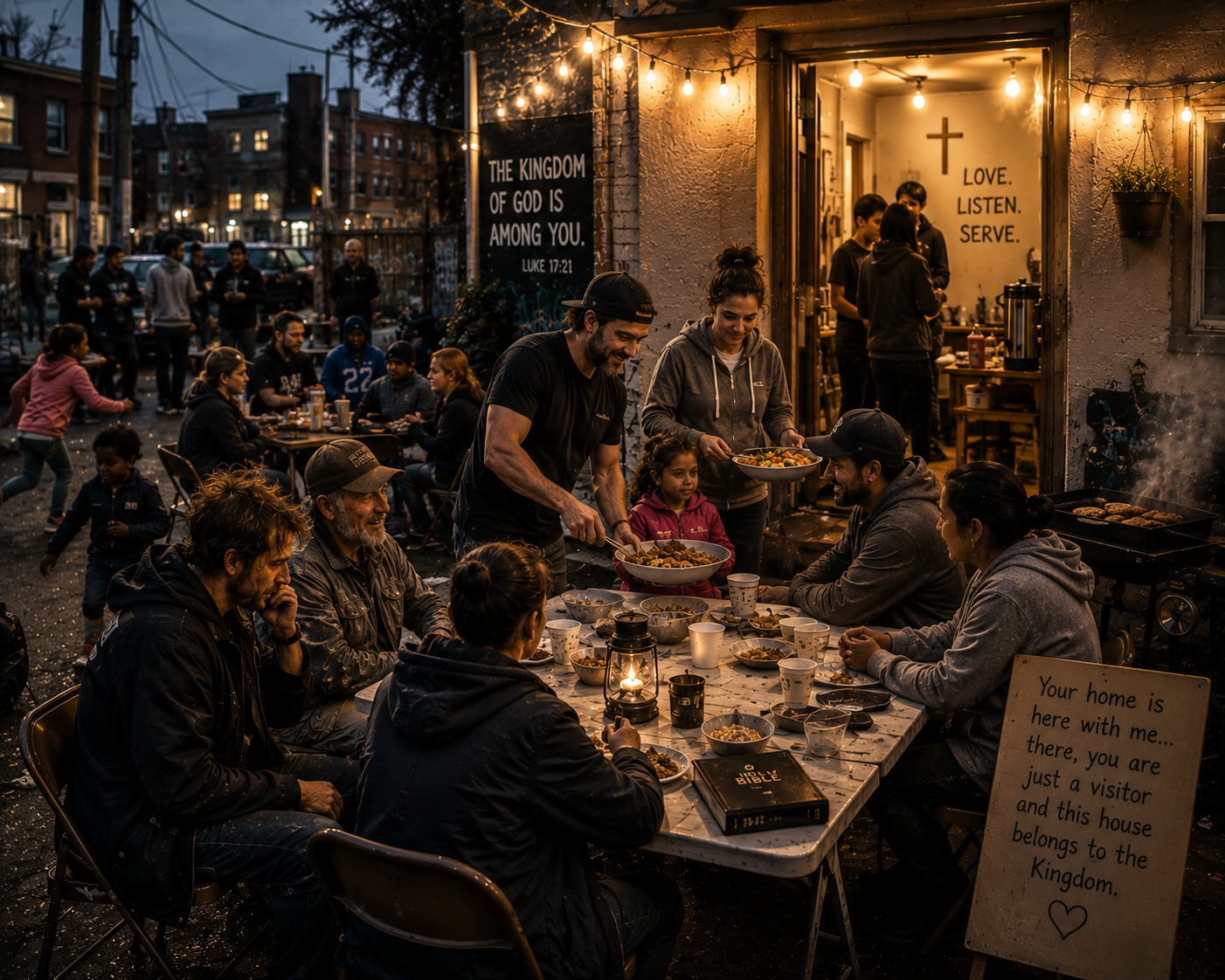
In Hochelaga, it was the same, multiplied by ten. The house was a hotel, a restaurant, a hospital. The only room off-limits to visitors was our bedroom. For everything else — constant comings and goings.
One morning, I was getting ready to leave for work at 8 a.m. Someone was already coming in. I quietly prayed to God to grant me peace in my home. His answer was immediate and clear:
« Your home is here with Me. There, you are only passing through. That house belongs to the Kingdom. »
I understood. And I continued. To make disciples means to share your life. Your home. Your table. Your vulnerability. It is not a metaphor. It is literal.
🏳️ Kingdom Ambassador — and Its Limits
The Bible compares us to ambassadors of Christ. An ambassador is appointed by the highest leader of a country to represent that country abroad. He does not represent himself. He represents his country. When he speaks, it is his country that speaks. When he acts, it is his country that acts.
One day, a young man came to see me. He was using drugs, suffering from it, manipulating those he loved, wanted to get out. I found him a place in a Christian transition house in Lanaudière. He answered me:
« I need help. But not a Christian thing. I want nothing to do with Christians. »
My answer was direct:
« How can you walk into an embassy, ask the ambassador for help, while telling him that the help he gives you cannot come from his country? I am an ambassador of Christ. This house is an embassy of the Kingdom of God. The only help I can offer you comes from there. I am sorry if you do not accept this help. »
He left. I never heard from him again. To help in the name of Christ is sometimes to accept that the person exercises their freedom and says no. It is not a failure of our mission. It is respect for their dignity.
An ambassador cannot offer the help of another country. He represents one Kingdom only. Be clear about the Kingdom you represent.
❓ The Two Questions That Cut Through — Mimo??
Since 1997, I often sign my emails « Mimo?? ». Mimo for Michel Monette. And the two question marks to spark curiosity. Those who ask me what they mean, I tell them: they represent two universal questions that I ask only if you commit to answering them honestly.
Here is the first question:
« Can you tell me where, in your surroundings — neighbourhood, family, work — you see God at work? »
I wait. I help if necessary. I accompany them in seeing the grace and love around them — in a school, a hospital, a park, a community centre, a daycare, a retirement home. Yes, sometimes even in a church. But rarely, I must admit, do people see God at work in the church.
Once the first is answered, I ask whether the person wants to continue. It is their choice. If yes, the second question:
« What are you doing to take part in it? »
The aim: to invite the listener to reflect on whether they are active or passive in the face of God's work in their environment. Watch out — going to church is not an answer to this question. Going to church does not make you a disciple, no more than sleeping in a garage makes you a car. Taking part in God's work can be as simple as kindly serving coffee at a shelter for the homeless. It may seem insignificant. But for the one who receives that coffee with a smile — it changes everything.
These two questions, I ask them to all who speak to me about mission, evangelism, church planting. Their purpose is to raise neighbourhood missionaries: Hope Brigadiers, Chaplains of grace, distributors of forgiveness, reconcilers of life.
💻 Mission at the Office — Yes, There Too
I was an IT consultant for most of my professional life. And at every new mandate, I did the same thing: discreetly look through address books, drop a few Kingdom values in a meeting or at lunch to see who reacted, and look for a brother or sister with whom to start a prayer meeting at lunch hour.
I have seen co-workers come to Christ in those meetings. I have seen believers strengthened. I have also seen closed doors stay closed. I let God open and close the doors. I am only a tool in His hands. That too is mission.
Mission does not start when you board a plane to Africa or Asia — even though that is a legitimate and necessary mission. It starts on your street, in your building, at your workplace, in your extended family. There, now, with the people God has already placed around you.
✨ It Is Up to You Now
Living for Christ is an exhilarating life, full of challenges, joy, and love. Not a life of programs. Not a life of spiritual performance. A life of presence. Of vulnerability. Of open tables and unlocked doors.
You are workers in the Kingdom of God. You walk with Him. And He walks with you — in your streets, in your offices, in your kitchens. He is already where you are going. Your mission: to join Him there.
Find the men and women of peace around you. Share your life with them. Let God do the rest. That is the whole mission.
— Michel Monette, Kingdom Ambassador. Mimo?? A disciple on the way.