A Mennonite blog post | By Michel Monette, a neighbourhood worker
📍 Moving Into the Darkness
Two books shaped my early years in church planting. « The Purpose Driven Church » by Rick Warren — which taught me to look for the universal principles behind the methods, even though Rick himself eventually gives in to the temptation of handing us recipes. And « A Theology as Big as the City » by Ray Bakke — an apology for God's love for the city, a resounding call to leave comfortable suburbs and return to the wounded city.
That second book convinced me to move to Hochelaga-Maisonneuve in 2004. At that time, Montreal was living through the largest gang war in its history. And that is precisely where I felt the call.
Where the darkness is thickest, a single small light — however thin and weak — can make all the difference.
This is not a romanticization of misery. It is an Anabaptist theological conviction, inherited from those who chose to settle in the midst of the persecuted and the excluded, because that is where Christ is found. Matthew 25 is not optional.
🌊 Swimming Against a Double Current
Very early on, I realized that planting a non-traditional church in an underprivileged neighbourhood means swimming against a double current.
Against the current of society, which has long rejected the church. And against the current of the church itself, which is still chasing its US-imported Sunday gatherings. I was misunderstood by my peers. I was being held accountable for my baptisms and new members. Here is what I once told my supervisor:
« Here is the membership of the church in Hochelaga: 50,000 people. They are all members of the body of Christ. They simply do not all know yet that they belong. If you want to know whether things are moving, the government runs a census every four years. I am not responsible for how God convicts of sin and righteousness. I am only a hope brigadier. »
This answer did not please. But it was theologically sound. And today, I still hold to it.
Our role is not to manage the numerical growth of Christ's Church. He is the one who builds. We lay bricks.
🗺️ Knowing Before Acting: the Exegesis of the Neighbourhood
Before acting, we sought to understand. With Direction chrétienne (Christian Direction) and Glenn Smith, we did a true exegesis of the neighbourhood: its history, its residents, its incomes, its leisure, its organizations, its food deserts, its zones of violence. Not to « target a growth strategy ». To listen to what God had already placed there before our arrival.
For God is at work before and after your arrival in a neighbourhood. Do not have the arrogance of believing you bring God with you in your luggage. You are not a colonial missionary. You are a catalyst of what Christ is already doing.
We saw churches arrive and leave Hochelaga without anyone noticing either their coming or their going. Jesus calls this « casting pearls before swine »: a waste of time and resources for the Kingdom. Useless buildings, cultural objects to defend but with no life, no anchor, no real impact on the neighbourhood.
⚠️ The Enemy of the Kingdom: the Pious Lie
A couple came to see me. God was calling them to plant a church in the neighbourhood. I rejoiced. I accompanied them. But I told them one very clear thing:
« Be transparent. Have no secret motivation. If you are planting a church, say so. If you are doing community work, say so. If you are doing both, say so. The truth will set you free. The lie will destroy you. »
They seemed to understand. They started a day camp for the youth of a public housing block. The wife worked with the sex workers of the neighbourhood. Precious work, dearly paid for, as fragile as crystal.
Then they sent a support letter to their backing church. The letter, faithful and complete, of course mentioned their church planting project. Published online. Found by the wrong people. A complaint filed all the way up to the local member of parliament at the time. Credibility destroyed. Work lost. The couple had to leave the neighbourhood.
The enemy is the father of lies. And he does not need your enormous lies to destroy you. Your small ambiguities, your double intentions, your undeclared motivations are enough. In a wounded and suspicious neighbourhood, transparency is not an evangelical option. It is a survival condition.
If you are planting a church — say so. If it is social — say so. If it is both — say so. Stay in the truth.
🛡️ Hope Brigadier. Chaplain of Dignity.
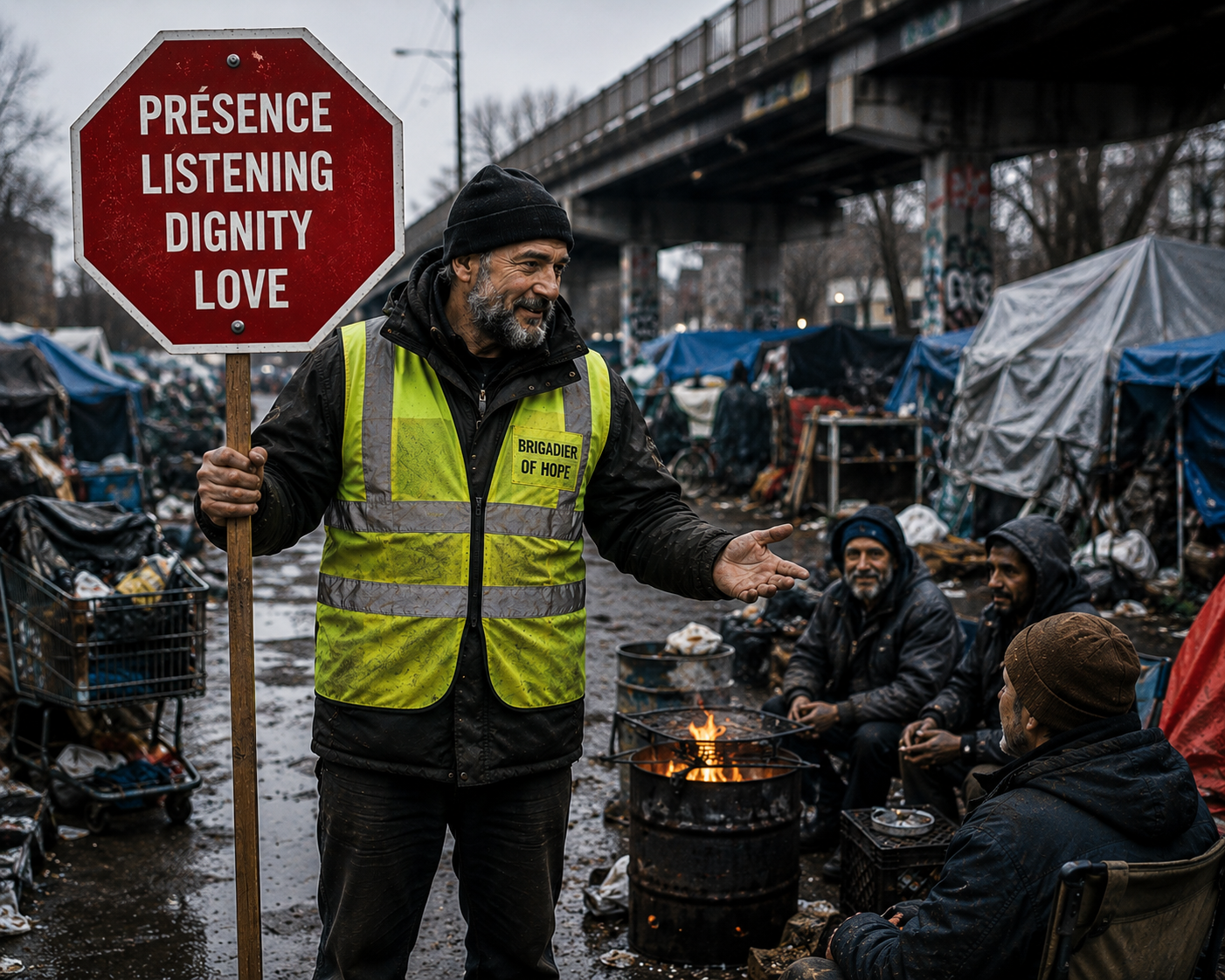
Two roles. Two names. Simple. Accessible. That neighbourhood people understand without theological training.
The « Hope Brigadier » directs, protects, guides, and controls traffic so that everyone is safe in the street — like a school crossing guard. His weapon: hope. His ground: people's daily life. His tools: his presence, his listening, his boldness.
The « Chaplain of Dignity » teaches, instructs, and accompanies the individual on every aspect of their life — spiritual, personal, practical. His weapon: dignity restored. Because that is what is most missing when you live in the street, when you beg for change, when you go to the food bank for your meal. Not a program. Not a Sunday service. Dignity.
You may call them Pastor and Deacon. The people of your neighbourhood do not know those words. But hope and dignity, they know. Very well.
🔧 Do Not Invent What Already Exists
Here is a classic trap: you arrive as Christians in a poor neighbourhood, and you want to open a food bank. It is praiseworthy. It is good. But is there already one in the neighbourhood? Could your disciples instead volunteer at the existing one?
A pastor came to ask my advice on opening a food bank in his church. His neighbourhood was a food desert. His members were motivated. The location was perfect. Then he told me why he wanted to do it:
« To save them. So they would accept the gospel and be saved. »
His answer saddened me. I told him: as soon as people understand your real motivation, they will stop coming. The neighbourhood organizations will pressure you to close. Feeding the hungry is already a work of the Kingdom. Matthew 25. You do not need another reason. Serve and watch God work.
Sadly, they never opened the service. The neighbourhood is still a food desert. Sometimes I wonder whether I should have simply encouraged them to start and see what happens. This is also a lesson for me.
👴👵 The Samaritans of the Golden Years
Here is a question no one asks: how are the elderly of your neighbourhood doing? Who does their groceries? Washes their windows? Goes to the bank for them? Walks with them? Above all — who listens to them tell their life?
The isolation of seniors is an invisible epidemic. And your group of disciples has exactly what it takes: time, a listening ear, human presence. Samaritans of the Golden Years. Not a special program. Not a Wednesday-night service. People who go to their neighbours' homes and stay.
👑 Your Kingdom Versus the Kingdom of God
During the early years of my ministry in the neighbourhood, I had the arrogance to say « my church, my vision, my plant, my way of doing things ». God took the time to show me his point of view. He was not working with me to build my kingdom. I was the one working with Him to build His. One person at a time.
I have seen young planters arrive in the neighbourhood with bags full of US-imported teachings, ignoring the history of the neighbourhood, ignoring local ecclesiologies, refusing to collaborate with women pastors and Catholics already present because it did not match their theology. I pray for them. May God show them, as he showed me, that it is His Church — and that he did not ask our permission to choose His family.
In a very poor neighbourhood, the church will remain small and changing. Accept it. It is not a failure.
The real failure is to have had no impact on the lives of people around you. But if you have given back hope and dignity to a single person during your time in this neighbourhood — that is why you were there.
Jesus, on his way to heal the daughter of Jairus, stopped for a woman who was crawling on the ground to touch the hem of his robe. A woman with no legal right to be there. He took the time. He healed her. He restored her. In her dignity. In her community. One single person was enough for Christ to stop and change the course of his day.
🍽️ A Meal in a Crack House
A man had been coming to our church for a year. He lived on the street. He used alcohol and drugs and came on Sunday morning fasting from almost everything — except alcohol. He loved to cook. My wife invited him to cook a meal for us at his place.
We gave him a grocery gift card and the following Saturday we arrived at his crack house — a rooming house for the homeless and users. I prayed quietly that God would protect my stomach. The table was sketchy. The pots, even more so.
During the meal, a man came in. He refused to eat. He felt unworthy to be at the table with us. He told me about his nightmares. About his bad dreams. He did not know how to chase them away. I looked him in the eyes and I told him:
« Today I forgive you all your sins. When the nightmares come back, simply invite Jesus into your dream. And you will sleep in peace. »
This man accepted that Christ had given his life for him. He was baptized one year later. Today, he is a street worker and helps other people get out. Does he relapse? Of course. But who among us does not relapse? Christ has forgiven all his sins — past, present, and to come.
To be a Hope Brigadier sometimes means having the courage to give hope where it seems least likely to be received.
✨ Go Into Your Cave
These are just a few stories about how we were Hope Brigadiers and Chaplains of Dignity in a dark and shadowy neighbourhood. These are not recipes. These are principles:
- Unconditional love — before any speech.
- The absence of judgment — as He practised it.
- Fraternal hospitality — including at a table you did not choose.
- Total transparency — without hidden motivation.
- Acceptance that it is Christ who builds His Church — and that you are only a tool in His hands.
Find your neighbourhood. Your shadowy cave. And go light the lamp there. Not with a five-year notice, a strategic plan, and a startup budget. With your presence. Your table. Your listening. Your hands.
You are children of Light. After all.
— Michel Monette, neighbourhood worker. A disciple on the way.