A Mennonite blog post | By Michel Monette, a Chaplain of Dignity
🤍 The Word the Church Stopped Pronouncing
There is a word the evangelical church has progressively erased from its practical vocabulary. A word that is nonetheless central to the Gospels. A word Jesus embodied at every encounter with the marginalized, the excluded, the impure, the unwanted.
That word is: dignity.
We talk about salvation. We talk about baptism. We talk about members, disciples, growth, vision, and strategic planning. But dignity — that fundamental recognition that every human being carries within them the image of God, the Imago Dei, regardless of their address, their debts, their addictions, or their reputation — we have traded it for programs.
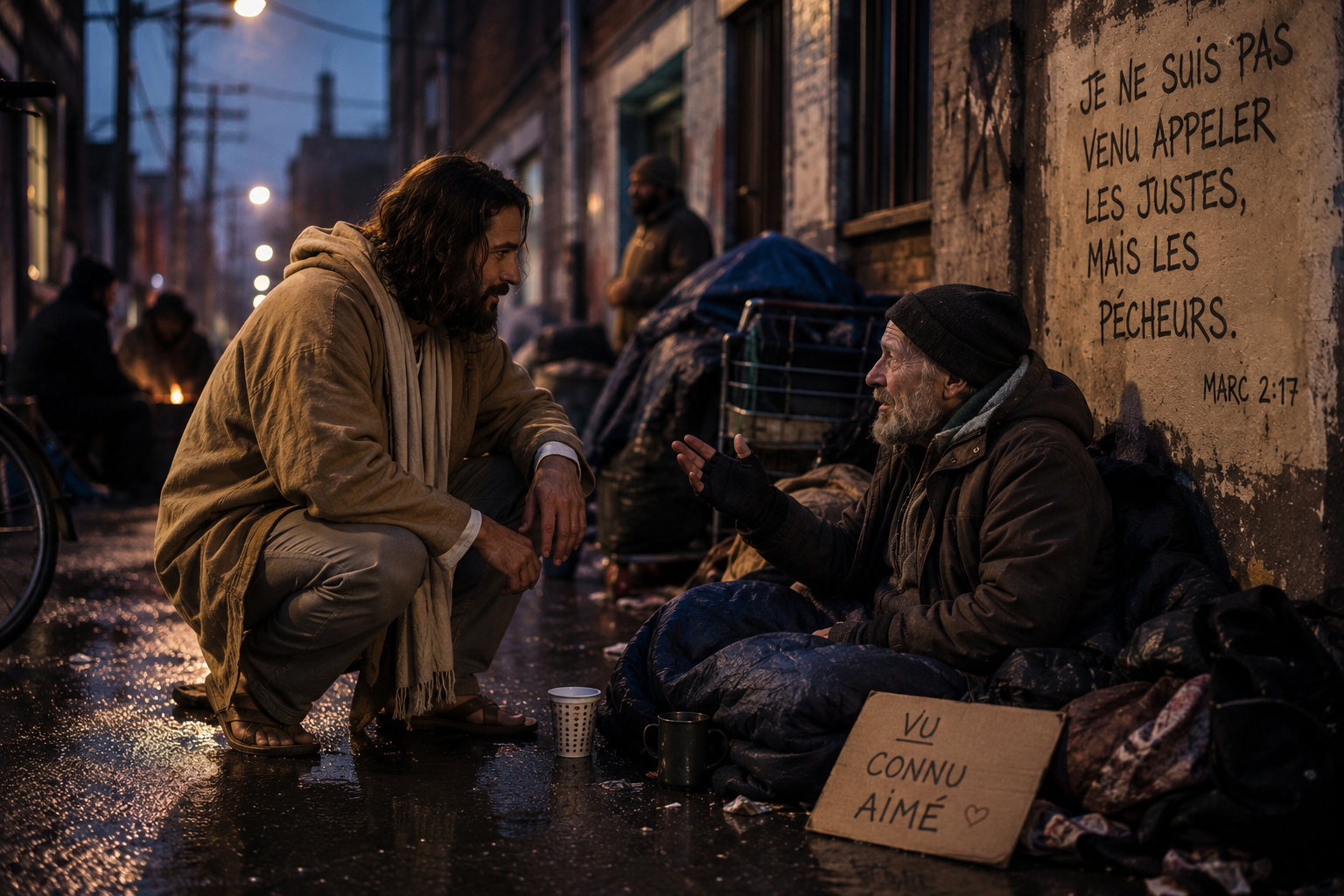
And in poor neighbourhoods, this absence is felt. Physically. People who live in misery do not lack only food or housing. They lack being seen as whole persons. The gaze of the Chaplain of Dignity is precisely that gaze.
The man or woman begging in the street has often lost every shred of dignity — and often every shred of hope. That is where we are called.
✝️ Begin With Renunciation
Planting a church in a poor neighbourhood begins with a radical counter-cultural act: renunciation. Not a romantic or performative renunciation, proudly announced in your support letter. A real, painful, deep renunciation.
Renunciation of your planter's pride. Renunciation of your vision of what « your » church should look like. Renunciation of your success metrics. Renunciation of the illusion that you have the solution.
You are not a church planter. Christ is the planter. You are a tool in His hands. A catalyst for what He is already doing in the neighbourhood — before your arrival, after your departure.
God has been at work in your neighbourhood long before you set down your suitcases. The Anabaptists have always known this: we do not carry God to the people the way a colonial missionary carries civilization to the « savages ». We join God where He already is. And we humbly ask: what are You doing here? How can I work with You?
The Brigadier directs and protects. The Chaplain teaches and accompanies. Neither builds his own kingdom. They serve Christ's.
⚙️ Do Not Invent What Already Exists — A Classic Mistake
Here is the most predictable trap for a Christian who arrives in a poor neighbourhood with a heart full of goodwill: wanting to create something new. A food bank. A community centre. An aid program. A childcare service.
None of this is bad in itself. But before creating anything, a question imposes itself: does it already exist? And if so — why duplicate what is already there, instead of contributing to it?
A pastor came to ask me for advice on opening a food bank in his church building. His neighbourhood was a food desert. His members were motivated. The location was ideal. I asked him:
« Why do you want to start a food bank? »
His answer saddened me:
« To save them. So they can accept the gospel and be saved. »
I told him directly: as soon as the people of your neighbourhood understand your real motivation, they will stop coming. The community organizations will pressure you to close. Because feeding the hungry is not a pretext for salvation — it is already a work of the Kingdom. Matthew 25. No further justification needed.
Sadly, the church never opened the service. The neighbourhood is still a food desert. And I have sometimes wondered whether I should have simply encouraged them to start — and seen what God would have done. This is also a lesson for me: imperfect action is sometimes better than perfect paralysis.
Serving the hungry is already a work of the Kingdom. You do not need a hidden evangelistic agenda for God to be glorified in your service.
👴👵 The Samaritans of the Golden Years
Here is a question no one asks at church planting Boot Camps: how are the elderly of your neighbourhood doing?
Not the seniors of your congregation. Your elderly neighbours. Those who live on the same street as you. Who does their groceries? Washes their windows? Cleans their home? Goes to the bank with them, pays their bills, walks with them in the park? Above all — who listens to them tell their life?
The isolation of seniors is a silent epidemic. Invisible in church growth statistics. Ignored in five-year vision plans. And yet — a few members of your discipleship group could become Samaritans of the Golden Years. Men and women who give the rarest gift of our hurried age: their presence.
Tools like Waybase have been created to help Christians better know their neighbourhood — its needs, its resources, its blind spots. Before launching anything, ask yourself first whether you can join what is already in place. Participate before creating. Serve before leading.
The rarest gift in a poor neighbourhood is not money. It is presence. Time. Listening. These are gifts any disciple can give — without budget, without venue, without program.
👑 Your Kingdom Versus His Kingdom
Let me be honest. During the early years of my ministry in Hochelaga, I had the arrogance to speak of « my church », « my vision », « my plant », « my way of doing things ». It is a common disease among planters — and it is enthusiastically transmitted in American training programs.
God took time to correct me. He showed me a simple but unsettling reality: He was not working with me to build my project. I was the one working — clumsily, proudly — with Him to establish His. One person at a time.
I have seen young planters arrive in the neighbourhood, hands full of US-imported training, refusing the pastoral table because women pastors and Catholics sat there. I understand their ecclesiology. It comes to them from their traditions. But Christ did not ask our permission to constitute His family. And His family is often much wider — and much more unexpected — than our denominational frameworks.
I pray for those young planters. May God show them, as He showed me, that the harvest is His work — not ours. That we are its workers, not its owners.
The church will remain small and shifting in a very poor neighbourhood. Accept it. It is not a failure. It is the nature of the terrain.
Only a small group of men and women will be able to remain in the face of human misery in a constant and continuous way. Others will come and go. Leaders will be renewed. And it is even possible that what you do will not pass the test of longevity.
You will then be tempted to believe you have failed. But the real failure, in this context, is to have passed through the neighbourhood without impact in anyone's life. If you have given back hope and dignity to a single person during your time there — that is why you were there.
🩺 One Person Is Enough for Christ
Jesus was on his way to heal Jairus's daughter. Medical emergency. Grieving father. A whole crowd following. A loaded agenda.
And on the way, a woman crawls on the ground to touch the hem of His robe. A woman with no legal right to be there. A chronic flow of blood that made her ritually impure — and made impure every person she touched along the way. In the religious logic of the day, she contaminated the crowd. She should have stayed home. Hidden.
Jesus stops. In the crowd. With Jairus's daughter's emergency before Him. He stops. He looks at her. He heals her. And on top of that — He restores her. In her dignity. In her community. He calls her « daughter ». He gives her back a name, a place, a belonging.
One single person to restore is enough for Christ to take the time to stop. Him, who carries the world. Him, who holds the agenda of eternity. He stops for one.
This is the heart of the Chaplain of Dignity. Not crowds. Not numbers. Not quarterly baptism reports. One person. Seen. Recognized. Restored.
🍽️ At Table in a Crack House
Let me tell you what happened one Saturday evening in Hochelaga.
A man had been coming to our church for a year. He lived on the street. He would arrive Sunday morning drunk and high, take advantage of the breakfast, call his mother from our phone, then leave. He told us he loved to cook. So my wife had the most evangelical idea she ever had: invite him to cook for us at his place.
We gave him a grocery gift card. The following Saturday, we went to his place. A crack house — a rooming house for the homeless and drug users. I quietly prayed that God would protect my stomach.
During the meal, customers came in and out to buy drugs from one of the men sitting at our table. We prayed. We ate.
Then a man came in. He refused to sit. He felt unworthy to be at our table. He told me about his nightmares. About his shame. About the inability he felt to stop doing what he was doing.
I looked him in the eyes. I told him:
« Today I forgive you all your sins. When the nightmares come back, simply invite Jesus into your dream — there where you sleep — and you will sleep in peace. »
This man received Christ that evening. One year later, he was baptized. Today he is a street worker and helps others get out. Does he relapse? Yes. But who among us does not relapse? Christ forgave all his sins — past, present, and to come. He did not need to be clean to be loved. He did not need to be sober to be worthy.
We went home that evening with the quiet certainty that Jesus had healed people around that unsanitary table. To be Chaplains of Dignity is to bring dignity where it is absent. Even if the table is sketchy. Even if the place is dark. Even if you prayed for your stomach.
🧱 The Foundation Stones
Behind all these stories, there are four principles I want to name clearly. Not as a recipe. As a foundation:
- Unconditional love — before any speech, before any expectation, before any condition of reception.
- The absence of judgment — because Christ did not condemn the prostitute, nor the tax collector, nor the woman at the well. He asked. He listened. He offered.
- Fraternal hospitality — including at a table you did not choose, in a place you would never have visited alone.
- Ecclesial humility — accepting that it is Christ who builds His Church, that you are only its workers, and that His family is much larger than your denomination.
These four stones do not require a budget. No venue. No five-day training. They require renunciation. Presence. And the courage to look a person in the eyes and see the image of God, even where it seems most erased.
✨ Go Find Your Cave
Find your neighbourhood. Your shadowy corner. Your sketchy kitchen table. Your elderly neighbour no one visits. Your man at the crack house who believes himself unworthy to be at your table.
Go without a preset program. Without a hidden agenda. Without a baptism quota to reach. Go with your presence, your listening, your table, and your open hands. And watch what Christ does.
For you are children of Light. And the light — even the smallest, even the most fragile — always overcomes the darkness.
To be a Chaplain of Dignity is to bring dignity where it is absent. Not tomorrow. Not with the next program. Tonight. At this table.
— Michel Monette, a Chaplain of Dignity. A disciple on the way.